Showing posts with label Kumasi. Show all posts

Thursday, August 12, 2010

Got to Have Faith: A Story About a Girl and a Ghanaian Boy…


Marriage proposals are timeless romantic vignettes that all girls, no matter where you fall on the romantic continuum, tell with a blushing smile. On my 68th day in Ghana, just two days before I had to reluctantly step onto a plane back to the US, I received my last ill-fated Ghanaian proposal.

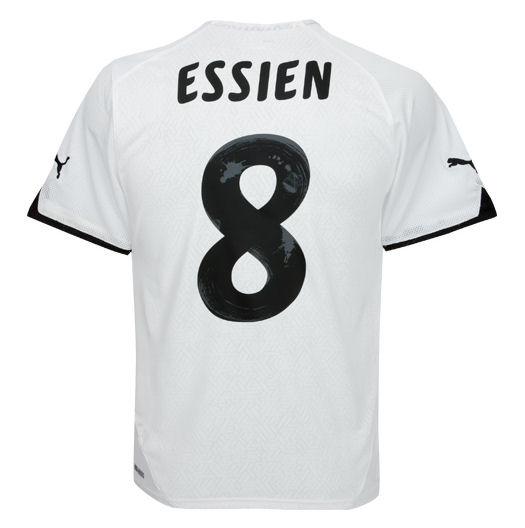
I was briskly walking out of the Clinical Students’ Hostel on a mission to find a Ghana Black Stars Eissen soccer jersey that would fit me rather than swallow me whole in its size. The sun was particularly vicious that mid-afternoon, so I had my hair pulled into a messy bun and was unashamedly wearing my oversized sunglasses. I knew exactly where I had to go: the soccer jersey stand directly across from the National Cultural Center. It had rained the previous day, so the nice gentleman selling jerseys did not set up shop. This was my last night in Kumasi, so I was holding my breath that he’d be there sitting among his cornucopia of multi-colored jerseys.

Just as I a turned the corner to walk down a relatively steep road nearly tripping on my AADT yoga pants that I’ve neglected to hem, I see a brawny Ghanaian step out of his parked car. With over 60 days of Ghanaian experience, I knew that I had no choice but to spend at least 5 minutes making small talk with this gentleman since my path would pass right by his car. “εte sεn?” he says. “εyε” I reply, “How are you?”

After exchanging the ubiquitously used greetings, he wastes no time to ask where I’m from and where I’m going. It turns out that he is a lab technician who works at the teaching hospital. If I wasn’t in a rush to find my elusive soccer jersey, I probably would have slipped into what I’m sure the Ghanaians think is annoying when I ask unending questions—it would have been a golden opportunity to find out more about the lab facilities at the teaching hospital. As I was explaining that I was here in Ghana doing research, my new Ghanaian friend adeptly transitions into a Ghanaian suitor as he interjects comments and questions like, “I’ve seen you around the hospital”, “You must be as smart as you are pretty”, “Do you have a boyfriend?”, “Why don’t you have a boyfriend?", and “I like watching you.”

He then asked with a smile one of the most common questions I have received in Ghana, “Are you a Christian?” Religion does not play a very large role in my life, if at all. Consequently, I was not prepared for the religious fervor in Ghana. Nearly everyone in the southern half of Ghana is Christian, while the north is predominantly Muslim. Although I don’t subscribe to a particular religious faith, I sometimes believe that some sort of organic higher power exists--the spirits of my ancestors, Mother Earth, Father Time, I’m not sure what to call it and this ambiguity has never been a concern of mine. Because Christianity and Islam dominate the spirituality of the Ghanaians and few, if any, are non-religious heathens like myself, most Ghanaians don’t understand my stance on faith.

To truly immerse myself in Ghanaian culture, I’ve made an effort to understand religion in Ghana. During my stay here in Ghana, I have had the fortune and pleasure of attending several different Sunday church services with colleagues and on health fair trips with the medical students. Attending church in Ghana is an indescribable experience that I highly recommend to visitors. If you thought Southern Baptist church services were high energy, just wait till you walk into a church that can seat more people than a high school football stadium with large movie screens on all sides of the room projecting the word of God. Every church service I have attended has not only a church choir with record-label worthy leads, but also a complete band including guitar, bass, piano, and drums. I couldn’t help but stand up and clap my hands with the church in enthusiasm for the dramatic performances. What was more impressive than the musical spectacle was watching each and every church attendant’s public display of their deep personal relationship with their faith. The word passion came to mind as I watched people raise their hands in the air to praise God, squeeze their hands tightly to their chests as if trying to pour out their love directly from their hearts, and simply look up with their eyes closed enveloped in serenity.

My exposure to the Muslim population of Ghana has been limited to my few excursions to the north where I’ve seen the oldest mosque in West Africa at Larabanga and several other beautiful mosques dotting the roads. At sundown, around 6PM, it is not uncommon to see mosques and other community centers filled with people praying on oriental rugs. My flatmate, Shy, is Muslim and I think he has been warmly welcomed by the Muslim community here in Ghana.

Unlike some of the previous suitors, my answer of “no” to the question, “Are you a Christian?” did not deter him. The persistent Ghanaian lab technician then asked if I was Muslim. My confidence that our conversation would end with my answer of “no” was shattered when he laughed and said that it was not possible for me to be neither Christian nor Muslim. Time was ticking and the image of my jersey vendor packing up his shop flashed violently in my head like a pulsating aneurysm ready to rupture. It was time for me to whip out my impatient American attitude. Even though we have no established relationship, it was time for me to dump my Ghanaian suitor.
    “I’m sorry for cutting this conversation short, but I really need to go. You are a very nice guy, but today is my last night in Kumasi and I have a lot of things to do in town before the sun goes down…”
Just as I was about to say, “It was nice meeting you,” he swiftly and smoothly interrupts me and offers to drive me into town. The preschool rule to never follow a stranger into his car is very relevant in Ghana and I was not going to “hitchhike” into this gentleman’s car to get to town. As if anticipating my refusal, he said that he has not finished getting to know me. Beads of sweat were now dripping down my face from the heat and weariness of this long and now unpleasant conversation. I decided to try one of the last tricks in my bag: outlining the infeasibility of us being friends given that I was leaving the country TOMORROW.

Usually, this statement is enough to prompt a retreat by the Ghanaian suitors…but not this one! Like an experienced Don Juan he explains that he does not believe that I am not religious because it is clear that God brought us together this afternoon, on my last night in Kumasi, to meet, to chat, and to fall in love. He argued that I could not leave because this act of God should be enough for me to believe. More importantly, how could I be so sure that he is not the one—my future husband and soul mate?

This silver-tongued Ghanaian suitor’s presumptuous flirting was really too much for me. If only circumstances were different: if we met in the US, if he was driving a slick convertible, or if he had a huge diamond ring and was ready to drop down on one knee, then maybe he’d be the one? No, under any circumstances within the realm of reality, some stranger I meet on the street for a brief conversation is not going to be “the one”. It took me a few milliseconds, but I thought of the perfect suave response that would give me the opportunity to leave him on the street and resume my jersey searching journey.
    “Then, don’t worry. If you are the one, then I’m sure God will find a way for us to see each other again. It was nice meeting you. Bye-bye!”
I gave a hurried wave, and was on my way. I even took the more precarious, unsuitable for flip-flops, cobble stone path to ensure that he would not follow me. I didn’t look back.

The end. My last Ghanaian marriage proposal. Will I miss these flattering street proposals from strangers when I’m back in the US? No, I don’t think so. Though hopefully the next time I decide to write about a marriage proposal, it will be of the sweet, romantic, and blushing variety.

Tuesday, August 10, 2010

Ghanaian Prints for Fall


What do you get when you send a fashion retard into a fabric store in Ghana, tell her to pick out cloth and then give specific designs to a Ghanaian seamstress to work her magic and transform the fabric into beautiful clothing?

With the help of the internet, the Marie Claire magazine that I found on my flight to Accra, and a very creative seamstress, I think I successfully avoided a fashion disaster. I handed over my fabric and hoped for the best! Tops are about 4-5 Cedi each and dresses are 8-10 Cedi each. The seamstresses have their own catalogs of traditional Ghanaian styles if you want typical Ghanaian clothing. I opted not to pick Ghanaian styles to increase the clothing's versatility in the US. I also don't think I'm curvy enough to do Ghanaian styles justice.


The seasmstress, Afriye, worked extremely fast and called me in after just a week for fittings. If there was any fabric left over, Afriye would design some extra tops for me! I highly recommend going with someone to the fittings so they can be an extra set of eyes for the little details. Shout-outs to Charlotte, Szoa, and my favorite dress-making partner, Mawusi, for helping me. Generally, simple styles are the most successful. After all of the minor adjustments, I think I'm very proud of what I was able to come up with! Afriye is a wonderful seamstress--I even got approval from Mawusi for Afriye's dexterity and creativity. So, if you are ever in Kumasi and would like to get something tailored...I'll pass Afriye's contact information onto you.

Are prints in this fall season? Well, even if they are not, I think Emily would approve of my wardrobe extension into print outfits! What do y'all think?

Tuesday, August 3, 2010

Party Hard: Clubbing in Ghana


Photo courtesy of Dimitri...all the body

While packing and envisioning my summer in Ghana, I was sure I’d spend every evening hidden away under a mosquito net in my room since I was convinced that being out on the streets at night was too dangerous to even risk it. I was also sure that Ghanaians also didn’t leave their homes at night, so a city nightlife would be completely nonexistent. However, at the same time, I knew that Ghanaians would have a innate sense of rhythm and everyone was probably a natural dance phenomenon. I unfortunately couldn’t connect these two ideas in my head and was completely unprepared for the vibrant clubbing scene in Kumasi that the medical students introduced me to.


Some of the most popular clubs that we frequented in Kumasi include Genesiz, Vienna City, and Café Masarati. The clubs are all fairly spacious and unlike the clubs I’ve visited in New York, Boston, Chicago, Ann Arbor, and LA, they are never very crowded— something I actually prefer. A typical night out begins around 11PM with pregaming. Since drinks in the clubs are similarly more expensive then on roadside bars, the concept of pregaming also exists in Ghana (interesting fact: pregaming is known as foreplay in Norway).


If you are a beer drinker than Ghana’s own Star Beer is very popular. For mixed drinks people like myself, vodka, gin, rum, whisky, and tequila are available, but it’s rare to see people drinking mixed drinks. After pregaming we all head to a club. Clubs don’t liven up until around 1AM and the night doesn’t really begin to wind down until 3:30AM. This is very different from the strict Puritan 2AM closings in Boston.


The music in clubs is about 70% local music: Ghanaian and Nigerian hits. Even though the music is completely unfamiliar, it’s not difficult to blend right in since the beats and rhythms are just like the hip hop and R&B hits played in the US. Unfortunately for Lady Gaga fans like me, you will never hear her music being played in clubs in Ghana, even when you request it. The music played complements Ghanaian dance and Lady Gaga just isn’t of the right swagger. Ne-yo, Usher, Chris Brown, and Rihanna are popular foreign favorites. I had absolutely no idea who Justin Beiber was before leaving the US. But, this 14 year old pop sensation has made it to Ghana and does get occasional air time.


Dance customs in Ghana are slightly different: no jumping up and down, no big circles of friends, lots of bumping and grinding, almost always guy-girl pair dancing and occasionally guys dancing together egging each on (not in a homosexual way), and sometimes more traditional dance moves are thrown in (not easy to imitate despite the med students telling me that I was getting it). There is almost always an imbalance of guys and girls in the clubs, so girls (who are not prostitutes) are in high demand. The clubs are really not for girls who are shy. I know I tried to make AADT proud :) I was incredibly impressed by all of the Ghanaian med students, especially the guys, in their dance abilities. They all know how to dance really well, which is a huge difference since finding guys who know how to dance or aren’t embarrassed to just try in the US is extremely rare. This is something that I’m going to really miss when I return to the US.
Here are some of the most popular clubbing favorites...I recommend y’all add them into your party playlist!


Thank you for all of the songs Ernest!

Sunday, August 1, 2010

If You Like Art...


My sister and I are very different people. Because we don't share many physical similarities, it's not easy linking us together as sisters. One of the major discrepancies is the distribution of talent. My sister is a natural creative artist. Her very first temper tantrum was actually about art. After spending at least an hour trying to understand through her tears what "yellow paper, white paper" actually meant (this occurred when the breadth of her vocabulary included at most 50 words), every member of the family was busy turning the house upside down searching for whatever type of paper product would fit her feeble sniffle-laden description. In the end, we discovered that it was the misplacement of her Disney's The Lion King notebook that became her very first sketchbook that elicited all of the screaming and crying. She has been drawing and painting ever since.

While I am to this day still very jealous of her artistic gifts, she has helped me develop a strong appreciation for the arts. A trip to the Met or MoMA in New York is really not the same if she is not there. Since she's busy in Shanghai this summer designing all sorts of buildings, I'm also on my own here in Ghana.


One of Bernard Mensah's pieces

While I may not have the same refined eyes of my sister, I do think that the traditional arts scene in Ghana is extremely vibrant. There are amateur artists all over selling any kind of traditional arts and crafts. For the sake of efficiency, I'd recommend Kumasi's National Cultural Center for your art and souvenir shopping fix. In the Cultural Center, you will find a wide variety of expertly skilled artisans with permanent shops that not only display their refined work, but also demonstrate how these traditional crafts are made. You can find wood work, kente cloth weaving, pottery, goldsmithing, paintings, and much more. During the summer for about 6-8 weeks, local artists from the city augment the crafts in the Cultural Center with their own wares (a perfect place to hone your bargaining skills).


One of Philip's pieces

Perhaps this is a result of my sister's influence on me, but of all of the traditional crafts I've come across in Ghana, the paintings created a unique impression on me. Although most of the paintings depict seemingly ordinary facets of Ghanaian life and culture, they truly are reflective of the Ghanaian spirit. Each painting is a kaleidoscope of colors and perfect blend of broad brush strokes and detailed minutia that seems to artfully capture the essence of Ghana. The subject of a painting may just be a single woman carrying a pot on top of her head and a baby on her back, but leaping off the painting is a tangible energy--a movement that draws you in.


Outside Philip's shop at the National Cultural Center in Kumasi

Since the National Cultural Center is just across the street from the Clinical Student's Hostel, I have had several opportunities to not just stop by to enjoy the beautiful paintings, but I've had the fortune of meeting the talent behind these masterpieces. My favorite artists are Philip and Bernard Mensah. I have picked up a few of their pieces to bring the Ghanaian spirit back to the US with me.

I may still be searching for my talent since artistry completely passed over me, but these artists in Ghana clearly have a talent worth sharing. If you are interested in any of their work, you can contact them directly: Philip (popg26@gmail.com) and Bernard Mensah (kwaboama@yahoo.com).

Saturday, July 31, 2010

International Exchange

The University of Michigan Medical School and most medical schools all around the US are missing out. By virtue of being an American Born Chinese, I have been directly and indirectly involved in international exchange for as long as I can remember. Many of my travels to countries around the world were a result of international exchange or cultural immersion programs and with the start of medical school, I knew that was an area of my life that would diminish drastically. But, being in Ghana has taught me that international exchange and travel is definitely still possible.

While staying at the Clinical Students’ Hostel in Kumasi, I have had the pleasure of meeting and getting to know several international medical students visiting Ghana for about a month on elective rotations in internal medicine, surgery, emergency medicine, and OB/GYN. Since nearly all of international travel at Michigan is sponsored and organized through relationships established by the University of Michigan Medical School and faculty, I assumed that all of the international students were here as a result of similar relationships. It turns out that I was wrong.

The International Federation of Medical Students’ Association (IFMSA) is a collection of medical students’ associations all around the world with 97 member nations from 89 countries encompassing 1.2 million medical students. Its activities include medical student bilateral exchanges, conferences, collaborative projects, and workshops. Projects include medical outreach and health education initiatives and others that provide medical equipment and medical education supplies to developing countries. The largest conference is the annual General Assembly. This year, the General Assembly is in Montreal and students from all around the world are currently traveling to attend this meeting.

The most unique programming that IFMSA provides is probably the bilateral exchange program. Through IFMSA more than 11,000 medical students annually have the opportunity to experience the practice of medicine in a health system different from their own country. Medical schools from the member nations develop contracts with each other: for every medical student from country A that comes to visit country B, a country B equivalent medical student visits country A. Since debt seems to be a general concern for all medical students globally, the bilateral exchange is a very cost effective way to engage in international learning. As a believer that cultural sensitivity cuts across all industries and fields, especially as global travel becomes easier and easier, I think these exchanges are playing a key role in developing a truly international physician workforce with a strong grasp of comparative health systems and the global delivery of health care. We all live in different countries, but despite these superficial differences, we all face very similar health care challenges: how to deliver quality health care to all.


In a more immediate time frame, having the IFMSA exchange students around has added greatly to the international flavor of my stay in Ghana. The best example I can think of is this international potluck dinner we had last Thursday. Each student was asked to make an international dish that best represents them. In a previous food post I had griped about the lack of the proper ingredients to make Chinese food, but after combing through the city of Kumasi, I was able to find all of the ingredients I needed to make Chinese pan-fried dumplings and guacamole (not meant to be eaten together). If I can make dumplings with just a small hot plate at my disposal, anything is possible in Ghana.


The dinner was a truly international affair. The Ghanaians made kelewele (spiced fried plantain bits), yam balls (fried yam balls with meat inside), and asaana (purple maize and pineapple drink). The Spaniards made Spanish omelets, sangria, and this light tomato sauce to be eaten with cured meats (various forms of jamon) and bread. Shy made samosas and chicken tikka. The Austrians brought chocolate and marzipan truffles. Mathias, although Swiss, represented Italy with some spaghetti. Dimitri made a yogurt based dish and brought in some delicious feta cheese on top of fresh tomatoes. The tables were packed with food. I’m happy to report that my dumplings (while I intended to make pork dumplings, I was given beef. Very unconventional…but still tasted good, haha) and guacamole were hits: no leftovers! We then danced the night away to Ghanaian, Greek and American music.


For unknown reasons, the US is a member of IFMSA, but very few exchanges occur between the US and other countries. If your medical school offers IFMSA exchanges, I’d highly recommend participating. I’m definitely going to look into this back at the University of Michigan!

Friday, July 30, 2010

Ponding


I have never been more thankful for a winter birthday than today. Every dorm, school, university, whatever locale has its own birthday traditions. All of them seem to mix a bit of humiliation and pain with fun. For most young people, their friends will take them out and get them drunk. Humiliation: losing all inhibition and doing the craziest things. Pain: nursing a hangover the next morning and piecing the fuzzy memories of what you did the previous night back together. Fun: your friends enjoy watching and egging you on in your drunken madness. In Jones College, my sister’s residential house at Rice University, you are thrown into a fountain on your birthday. Humiliation and pain: being thrown into a fountain and getting soaked against your will. Fun: your friends enjoy your reaction.

Here at KNUST, the tradition is that you are “ponded” on your birthday. Let’s break the word down. A pond is a body of water and to pound means to hit or to beat. So, what is “ponding”? On your birthday, your friends publicly clobber you with buckets of water for thirty minutes! Humiliation and pain: being pummeled with water. Fun: throwing water on your friend and watching his reaction.

Without any mercy, your friends slap the water on you from all directions: left, right, from above and below. If you try to run away or hide, your friends will drench your bed with water. The only way to avoid a ponding on your birthday is to be away from school.

Today was my friend Edwin’s birthday and he made the most unfortunate decision not to go home for his birthday. At 11:30PM, his friends began to troll the hallways of the dorm. They lurked around his room and called each other periodically to see if anyone had seen any sign of him. His faithful roommate did his best to hide his whereabouts. I admittedly am a guilty accomplice to his capture. I called to ask where he was and even though he gave me false information, his response tipped off his friends and he was found. Poor Edwin was dragged out into the courtyard and the ponding commenced. You would think that in Ghana, since water can be such a scarce resource it is possible that ponding can be avoided or at the very least a ponding session would never last thirty minutes because you’d run out of water. Unfortunately, in the middle of the courtyard is a large polytank, a water reserve that can hold hundreds of gallons of water. Once captured, ponding is unavoidable.

At the end, Edwin was not only soaking wet, but you could see welts on his back like he had just been whipped! I can only think of one piece of hope that can help you withstand the pain of being ponded: everyone will eventually get his turn. So, if you can avoid it, try not to celebrate your birthday in Ghana, or it will be a wet one!

Tuesday, July 27, 2010

Revolting: Tro-Tro Pharmaceuticals


Tiny little pills have become one of the most important currencies in medicine. Managing hypertension? Take X. Suffering from a bacterial infection? There is an entire alphabet of antibiotics available to you. Don’t underestimate these little pills, they have the power to completely alter a body’s normal processes, even the processes that keep the heart beating and you alive. As a result of this incredible power packed into pills, most drugs and pharmaceuticals are tightly regulated. Patients don’t have access to many of them unless a doctor’s prescription is provided to a pharmacist who then dispenses the drug to the patient. While the physician’s power of the pen has been criticized in the health reform discourse for driving up the health care costs in the US through overprescribing medications and ordering too many tests, my shocking experience on a Ghanaian tro-tro this morning sheds some light on a more positive dimension of a physician’s pen and the importance of health literacy among patients.

For the last three weeks, to cut down on transportation costs, I have been taking public transportation to reach the district hospitals that I visit and assess. Tro-tros are a widely used form of transportation and as a result of its common use, it is a main hawker target. All sorts of vendors selling bread, Ghanaian snacks, water sachets, toothpaste, flashlights, handkerchiefs, really anything come to the side of the tro-tro just before departure and almost every time the tro-tro comes to a stop (at traffic lights or pit stops) to sell items to passengers aboard the tro-tro. Occasionally, lay preachers will also board the tro-tro to preach the word of God or bless the journey. The swarming of hawkers has never bothered me since I’ve seen it as a convenient way to pick up the things I may need before every trip. The preachers also never seemed to bother me since I have a deep respect for the religiosity of the people of Ghana. But, this morning, I witnessed the grossest form of exploitation and felt powerless to intervene.

Pharmacies, called chemical shops in Ghana, dot the country and many of them are privately owned, through may or may not be staffed by pharmacists. They stock all sorts of drugs from common over-the-counter drugs, basic ointments, antibiotics, a handful of illegally stocked drugs, and all sorts of concoctions that claim to cure all ailments. Whoever staffs the shops freely provides medical advice and definitely does not work in coordination with physicians or medical institutions. Unlike pharmacies in the US, prescriptions are not required. This has HUGE implications on the misuse of drugs, not to mention the promotion of antibiotic resistant strains of bacteria.

So, here’s what happened. Just after the tro-tro door closed and we began our journey, who I thought was just an ordinary passenger stood up and began his energetic speech in twi. At first, I thought this gentleman was just another lay preacher, but every so often I’d hear words in English: “medical doctor,” “kidney,” “teaching hospital,” “brain,” and “X million Ghana Cedi.” Perhaps, he was blessing and praying for everyone’s good health. Then I noticed that he had an anonymously produced booklet titled, “Hepatitis B.” What was going on? Was he trying to sell this booklet about Hepatitis B? I then heard him say “prevention is better than killing” and he pulled out a package of drugs that he was selling for 1 Cedi. Like obedient students, almost everyone on the tro-tro handed him money in exchange for a tiny box labeled Ben-70s. I couldn’t believe it. How could they be so trusting of this salesman. I asked the student accompanying me to the district hospitals who he was and he said that he never introduced himself. The gentleman ended up selling two packages of drugs earning him at least 20 Cedi in just one tro-tro.

The closest thing we have to this in the US is direct consumer advertising. I’m not going to even open up the discussion of how manipulative the TV commercials and print ads can be. At the very least, these ads always end with the statement that consumers should ask their doctor about Y drug. While we can’t regulate the type of consultation patients receive from doctors about the drugs, at the very least, we can regulate their access to drugs that have the potential to be harmful if their effects and indications are not understood. A positive aspect of the power of the pen.

Embedded in my research this summer and critical to reducing maternal mortality not just in Ghana, but worldwide is health literacy and patient education. If only you could see the looks on the faces of the midwives and physicians that I interview who discuss abortion complications with me. At the root of these cases is a desperate and uneducated woman who takes some herbal concoction that causes her to bleed profusely and begin to circle death. Even though the human body has incredible defenses and regenerative abilities, would you really risk injury and death at the word of some stranger who doesn’t have the courtesy to mention his qualifications?

If the 1 Cedi drug was advertised to prevent Hepatitis B, what are the possible outcomes of this tro-tro transaction? Assuming the drug itself is a sugar tablet, the tro-tro passengers would take the drug and happily believe that they have succeeded in preventing contraction of Hepatitis B. They will not be interested in getting the Hepatitis B vaccine, proven standard prevention against Hepatitis B, and will remain unprotected. Down the road, they may come into contact with bodily fluids contaminated with Hepatitis B and become infected. Because one can live with Hepatitis B without immediate symptoms of liver damage, they will not seek care until their liver has been overtaken with cirrhosis. The most tragic part of this likely trajectory of events is that at the point they seek care, if treatment is still an option, it will be too expensive. Now it doesn’t surprise me that there are so many hepatitis and cirrhosis cases at the teaching hospital.

Perhaps it’s radical to say this, but the salesperson just earned 20 Cedi for committing murder. Never again will I ever complain about being forced to make a doctor’s appointment for a prescription refill. It’s a premium I’m willing to pay for receiving medical advice from qualified health professionals and peace of mind that others are going through this too.

Sunday, July 25, 2010

My Chinese Food Fix


Total Mangos Eaten: 9
Total Mosquito Bites: 22
Total Showers Missed: 2

This must be a sign that I’ve completely adjusted to living in Ghana because I am no longer frantically trying to create new mental maps to fit in all of my Ghanaian experiences. Instead, I’m falling back into old habits that I had in the US. The most obvious habits are my feeding behaviors.

I love to snack and have the biggest sweet tooth. My food counter used to be filled with my Cliff bars and fruit that I had picked up in town. But, slowly local cookies and sweets are crowding the counter. This is an unfortunate detriment to the maintenance of the weight that I have happily lost in Ghana.

Moreover, as if I was pregnant, I also developed insurmountable cravings for Chinese food. I can no longer convince myself that the Ghanaian fried rice sold on the streets is real Chinese food even though soy sauce is used to prepare the rice. My sisters delectable pictures on her blog are cruel reminders of all that I cannot have and the gluttonous delight I usually derive from eating fried plantains is slowly diminishing.

My flatmate, Shy, had suggested going out to eat Chinese food several times before. The thought of being disappointed by Ghanaian-Chinese food used to illicit the ugliest repulsive look on my face, but as the weeks passed and my sister’s food accounts increased in number while she was traveling on the China Synergy Programme, my mind became singularly fixated on wontons. My desperation had grown to a point that if someone offered me a wonton for my kidney, I’d probably say yes without a second’s hesitation. As we pulled back into the Clinical Students Hostel after a bumpy ride back from a weekend trip to Cape Coast, I woke up from my fitful sleep and proclaimed that tomorrow I’d eat Chinese food.

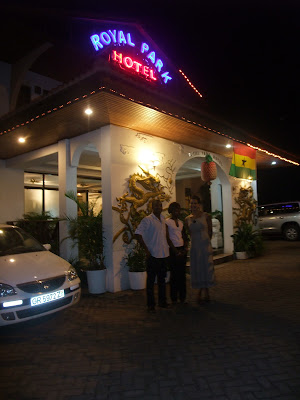
China’s presence is really inescapable in Ghana and there is no shortage of Chinese restaurants. After consulting with some of the Ghanaian medical students, we decided that Royal Park Hotel probably offered the most authentic Chinese food in Kumasi. After anxiously anticipating the food all day, we arrived at the door steps of the Royal Park Hotel, which was fully decorated with comforting Chinese vestiges—golden dragon wall hangings, stone guardian lions, and a big red carpet with the characters Huan Ying Guang Ling 歡迎光臨 (Welcome).


When we walked in, I saw other Asian people in the restaurant—always a good sign, even in the US, that the food should be decent. As we sat down at our round table complete with a lazy sally, I felt like I had reached my oasis. I poured through the menu and ordered over 40 Cedi worth of food, just for myself. They sadly did not have my wontons, bok choy, or the beef chowfun that would have made the perfect meal, but over six pages of other good options. I ended up ordering Jiachang Tofu 家常豆腐, beef lomein, Royal Park’s twist on lettuce wraps, and pan fried pork dumplings. The fatty in me made a valiant effort to clear the table in one sitting and I ended up with just two take-out boxes…not bad, right?

My overall opinion of Royal Park’s Chinese food? Out of five stars, I’d give it three. It was certainly better than Panda Express or your average Chinese American restaurant called any iteration of Lucky Bamboo or Happy Ding. But, it wasn’t fabulous. If in the US, Royal Park would not be a Chinese restaurant that would deserve a second visit. But, since I’m in Ghana, if I’m ever overcome with the overwhelming need to eat Chinese food, I’ll be back at Royal Park devouring another four dishes on my own.

Hair


I am kind of a failure of a girl, in that I don’t really know how to keep my hair at a level much higher than a mess. I know how to wash it, condition it, brush it, and blow dry it, but switching between leaving my hair down to pony tails is really as fancy as it gets with my hair. Now that I’ve been in Ghana for about two months, I can confidently say that my hair skills earn me absolutely zero brownie points in Ghana. I cannot compete with the constantly changing braids, cornrows, fros, curls, and updos that I’ve seen in Ghana. How do Ghanaian women manage so many different beautiful hairstyles?

For as long as I can remember, black women’s hair has always been a fascinating mystery. I can still remember hanging out in the band room on football game Friday’s in high school watching several girls get their hair done in cornrows as we waited for call time when we’d change into our marching band uniforms. The process and finished product just looked so cool! Since then, I always thought that black hair was special, equipped with qualities that my hair would never ever know.

It wasn’t until I came to Ghana and accompanied the hospital administrator to the hair salon, that I learned about a different take on black hair. As the hospital administrator’s wife sat in the chair getting her hair styled, she said, “See Eva, look at all of the pain and trouble we black women go through just to get our hair to look like yours.” What was she talking about?

I turned to Chris Rock’s documentary, “Good Hair” for answers. The premise of the documentary is that Chris Rock’s daughter came crying to him asking why she didn’t have “good hair.” Baffled by her sadness as much as I was by the hospital administrator’s wife’s comment, he decided to investigate what “good hair” meant. “Good hair” sadly means obroni hair. And the hospital administrator’s wife was right. To get obroni hair, black women have to go through a lot. Even after watching the documentary twice, I think I still have only a very basic understanding of the complexities of black hair. Relaxers (chemically hazardous derivatives of sodium hydroxide) to smooth out hair and weaves (produced in India) are just the basics covered in the documentary. And those beautiful braids? According to my friend Charlotte, those braids cost about $180 to get done in the US (just 5-10 Cedi in Ghana). It’s not just a financial consideration, it can sometimes take about five hours just to get your hair done.

I highly recommend Chris Rock’s “Good Hair” for the curious. While some may think it’s a simple message, I agree with Chris Rock’s final conclusion that there is no such thing as specific “good hair” because whatever hair you have, it’s all good.

Tuesday, July 13, 2010

Another Ghanaian Food Update

The Ghanaian food journey continues. Below are some local food highlights. I don’t think variety is a characteristic of Ghanaian food…I just may have tried it all within three weeks!

Before I go on, I will admit that I broke my rule of not eating any non-local food within the first week I was in Ghana. We discovered the famous obroni restaurant, Vic Baboo’s, while wandering around Kumasi and just had to stop in to try it out. Vic Baboo’s is an Indian restaurant that claims to serve local food, American, Italian, Indian, and Chinese. I went with Indian since it was an Indian restaurant and Erika went with Hawaiian pizza--both were pretty good!

Sir Max is another obroni option in Kumasi that I think is owned by Lebanese folk. We went to Sir Max with a few of the Ghanaian med students and I don’t think they are big fans of middle eastern food. I think they were actually disgusted by the baba ganoush I ordered.

Fufu


Fufu is a very unique type of Ghanaian dish. It looks like a ball of dough, but is actually pounded and mashed plantains and cassava mixed together. I think the mixed ball of dough is then boiled/steamed, but I’m not sure, especially since obroni usually get diarrhea after their first time eating fufu (thank goodness this didn’t happen to me!). Fufu is eaten with light soup, a spicy tomato based stew that has meat and fish poured on top of it. What may be fun for some is that you typically eat this dish with your hands. I say “fun for some” because I have this inexplicable fear of eating in public because I don’t like making a mess while I’m eating and having everyone see it. I generally avoid foods like ribs and wings when at restaurants even though I think they are tasty. I prefer a white pasta sauce over red and I eat messy finger foods with utensils. So, you can imagine how painful it was for me to eat fufu with my hands especially when the hospital administrator’s wife was staring at me. I was told that you were not supposed to chew on the fufu and just swallow it. That’s not difficult to do, but it seems so strange. So, I’d let it slosh around my mouth once or twice to taste it and then swallow. The fufu is kind of bland and tasteless. You can almost taste the plantain, but not really. I thought the light soup was super spicy. I guess the fufu is a good flavor balance to the light soup. After humoring the hospital administrator’s wife by eating with my hands. I gave up and asked for a spoon.

Just a few days later, the hospital administrator’s wife asked me to help her prepare fufu. It is usually prepared by two people. One person sitting by the mortar adding water to the mixture and folding the “dough” and the other person standing holding a large stick of bamboo with a flat blunted end to act as the pestle. I was very unsuccessful at the pounding because I was afraid I’d squash the hospital administrator’s wife’s fingers. I was also very reluctant to put in work and energy after showering into something I didn’t think was all that appetizing. The cost of sweating was not worth it! Thankfully, I think she got frustrated with my hesitant pounding and asked a scrawny fifteen year old to help her who was much more forceful with her pounding. Cost: 2 Cedi

Banku


Banku can be seen as a variation of fufu, but made of slightly fermented maize meal and mashed cassava. Banku also has that big ball of dough appearance but has a little more stiffness to it…kind of like oatmeal that doesn’t have enough milk in it. Instead of light soup, Banku is eaten with okra (okro in Twi) stew. If any of you have cooked with okra before, you know that it has a sliminess to it. Chopping up okra leaves is actually slimier. The okra and okra leaves are what give the soup is gooey texture. The okra stew is also tomato based and includes palm oil (red in color) and fish. Banku is also eaten with your hands. I never thought I’d be thankful for the power going out, but I used my difficulty of eating in the dark to get a spoon to finish off my Banku. I actually really enjoyed Banku. I think it’s because I really miss the taste of vegetables! Cost: 2 Cedi

Jollof Rice


Jollof Rice is a spicy type of rice usually served with chicken. I’m not quite sure what actually gives it it’s orange color and spicy taste, but my guess is the red pepper that’s used in almost every Ghanaian dish. It could also be Shito sauce (a horribly named spicy tomato/fish sauce). My guide book calls this the West African paella, but I haven’t seen Jollof rice served with anything but chicken, so I don’t think that’s the best description. Cost: 3-5 Cedi

Rice/Noodles/Yams with Tomato Stew


Because food is extremely hard to come by out in Agroyesum, the Matron’s sister cooked for me while I was there. I think it’s now clear that she’d try to cook me “American” dishes for dinner, which I really appreciate even though everything came with a Ghanaian twist. Most of my Ghanaian-American dishes included a starch (rice, noodles, yams) along with a tomato based stew that included either chicken, beef, or fish with some chopped cabbage, green pepper, and onion mixed in. The tip-off that I was eating Ghanaian-American dishes rather than true Ghanaian dishes was when I got an entire pot filled with French fries in it and when I offered them to the hospital administrator’s family, they refused them! I’ve never met anyone who didn’t like French fries. They said that they didn’t like potatoes. This confuses me since I don’t think potatoes taste all that different from the water yam… Cost: 2-6 Cedi

Red Red


In my previous blog post about Ghanaian food, I described fried plantains served with a bean stew. It has just been clarified that this dish is called Red Red. I still think hands down that fried plantains are my favorite Ghanaian thing to eat. Cost: 2-8 Cedi

All of the above are sold on the streets, though, unlike other countries I have visited, street food is a lot less common in Ghana. You can’t really eat your way through a city. I think this is why eating and finding food is so difficult in Ghana. A trip out to get food always takes at least an hour (not including the incredibly slow service at restaurants). Below are few things that you can also pick up on the street but are not really restaurant menu items.

Ghanaian Sandwich


I don’t actually know how common this type of sandwich is, but here’s Ghana’s take on an American staple: bread, onions, lettuce, chicken, beans, hard boiled eggs, ketchup, and mayo. I bought this sandwich as alcohol poisoning prophylaxis, but I think the combo of ketchup and mayo only added to me confirming any American partying stereotypes. :( Cost: 2 Cedi

Fried Egg Sandwich

If you are really craving a nice departure from rice based meals or need a quick protein heavy breakfast, a fried egg sandwich is a great cheap option. The fried egg sandwich is exactly that, but a few things to keep in mind: 1) The eggs are smaller in Ghana and the yolk is not very yellow. Don’t be fooled, egg whites only is not the standard here. The yolk is in there somewhere. 2) Without even asking for it, you will sometimes get egg sandwiches with a few diced tomatoes and green onions (aka the Ghanaian Spanish omelet). Beware if you don’t like tomatoes or green onions. 3) Bread is sold by length rather than slices. To make a sandwich you’ll probably need about 30 peswas (Ghanaian cents) worth of bread. Cost: 1 Cedi

Meat Pies


If you’ve ever been to a potluck that my family has been invited to, you will know what Chinese curry pockets are. I like to think that this is Ghana’s version of my mom’s Chinese curry pockets. The Ghanaian version is really just a meat pie that normally doesn’t have that much meat in it. I can’t put a finger on the spices in the meat. One meat pie had a sun-dried tomato flavor to it. The pastry portion of the pie is very flaky and very dry, so eat with plenty of water! Cost: 50 peswas to 1 Cedi

Goat/Beef Kebobs


Of all of the advice my mentor gave to both Erika and I before leaving us in Ghana to fend for ourselves, he was most enthusiastic about Ghana’s goat kebobs. This is definitely your typical type of street food: a guy standing behind a unstable looking grill. These kebobs can be of any type of meat, but I’ve seen only goat and beef so far. You can also get any part of a cow, except I have not seen cow tongue, which I told one griller would be a hit, but he didn’t believe me. The meat is marinated in the same red pepper and the kebobs are cooked upon order. So, as you are salivating, you are also praying that the meat is cooked well and that the hot metal grid is hot enough to kill anything that could kill you! Cost: 1 Cedi per kebob

After almost a month in Ghana, I’m seriously craving some good Chinese food. My sister’s Shanghai food pictures only add to my cravings. After Erika’s very unfortunate Chinese sweet and sour chicken at Vic Baboo’s I’m going to steer clear of anything Ghanaian-Chinese…It’s really too bad that I’m flying back straight to Ann Arbor, where the Chinese food is not really great. I really should make a pit stop at home!

Sunday, July 11, 2010

The Entire Country Weeps

Tonight is the final match of the World Cup: Spain vs. Netherlands. I can’t believe I’ve been following soccer for so long and feel so fortunate that I got to be in Ghana to really experience it. I’ve never seen an entire nation of people united for one sport. The excitement during the Super Bowl is nothing compared to the palpable fervor and energy of the World Cup. There are hoots and hollers for every referee call and steal. And the celebration that ensues when the Ghana Black Stars win is unparalleled. There is singing, dancing, chanting, and drum beating on the tables and chairs. Shakira’s World Cup anthem has even become a Ghanaian clubbing favorite!


I caught World Cup fever and have become a huge supporter of the Ghana Black Stars. Without much effort, during the quarterfinals match (Ghana vs. Uruguay), I was on my feet cheering for joy for goals and could feel my pulse increase whenever Uruguay approached the Ghana goal. My heart was on the line as the overtime minutes ticked and Ghana and Uruguay remained tied at 1-1. I didn’t just wish with every ounce for the Ghana Black Stars to prevail and continue towards the World Cup Finals, but also dreaded to see what would happen if the Ghana Black Stars were to lose.

If you want to see ultimate soccer drama, the Ghana vs. Uruguay game would be a perfect specimen. The last few minutes of overtime were oozing with drama. Ghana kicks a goal only to be thwarted by a handball by the now infamous Uruguay player, Luis Suarez. For his handball, the referee gave Suarez a red card pulling him out of the game and awarding the Black Stars a penalty kick. So much was riding on that one kick and Ghana Black Stars star, Asamoah Gyan overshoots his kick and just barely misses the goal putting the Ghana Black Stars in the unfavorable position of one on one penalty kicks to determine the ultimate winner of the match. When Gyan missed the shot, the medical school dorm JCR was silent with disbelief. I think I may have even stopped breathing. Not only could you see the heads of team Ghana hang low, but the feeling of demoralization permeated the room. Ghana’s succession forward was hanging by a thread and the psychological odds were not in our favor.

In the end, Uruguay succeeded in scoring more penalty shots than Ghana. The Black Stars players’ faces were covered in anguish and some of them even hid their heads under their jerseys. If I ever felt like crying over sports this was it. Sure, it was a huge upset to see the Ghanaian World Cup journey end here, but my heart went out to the Black Stars for their valiant efforts. They were not just holding the hopes and dreams of their country, but the entire continent of Africa as the only African team to make it past the first round of games and potentially make history by playing in the semi-finals.

Although I had lost my appetite, I walked out with the Ghanaian medical students to find food. The joyful chatter that usually fills our interactions had deadened. The usually busy and lively Bantama High Street was languid and morose. The entire country had taken a beating in that game. The only thing you could hear on the streets were arguments about the game and curses against Luis Suarez.

Since then, my interest in the World Cup has halved. I don’t particularly care who wins anymore except that I vehemently do not want to see Uruguay make it any farther. I peeked my head into the JCR during the Uruguay vs. Netherlands game briefly just to check that Netherlands was winning. Yesterday, I sat through the second half of the Uruguay vs. Germany match, again, only to cheer for the loss of Uruguay and hope that Luiz Suarez would get injured while playing.

Despite the disappointing loss, the Ghana Black Stars are being lauded across the country and the continent for making it as far as they did. They represented the country and all of Africa well and everyone is confident that Ghana has only more surprises for the world in the next World Cup. On the flip side, Luiz Suarez has become public enemy number one and his infamous handball has been deemed “Hand of the Devil” countering Maradona’s infamous “Hand of God” handball. If I were Luiz Suarez, I wouldn’t plan any vacations in Ghana…ever.

Here are a few news clippings of Ghana’s loss.


While my favorite sport to follow is still basketball (in case y’all haven’t been paying attention, D-Wade, Chris Bosh, and Lebron James will ALL be playing for the Miami Heat!!!!), soccer has become a close second. At the very least, I will definitely be cheering for the Ghana Black Stars in the next World Cup.

As for who will win tonight? I’ll side with the octopus…Spain.

Saturday, July 10, 2010

Calling All Fashionistas!

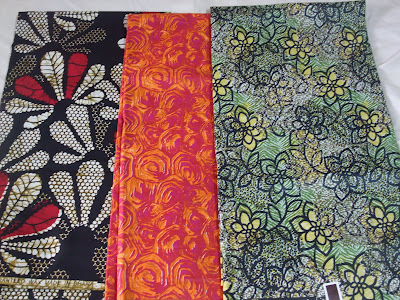
A popular thing for tourists to do when they come to Ghana is to buy beautiful cloth and ask a tailor to make some custom clothing. Yesterday (July 9), Charlotte (UMich Med School) and I ventured out into Kumasi to do just that.

You can find cloth almost anywhere around Kumasi like at the famous Kejetia Market (largest open market in West Africa). However, you can never be too sure about the quality of the cloth purchased from the streets. Charlotte and I went to two boutiques just off of Kejetia Market near Prempeh II Road called Da Viva and Woodin. The cloth at both shops are beautiful!

The next step is to find pictures or make drawings that specifically detail how I want the tailor to transform these beautiful piece of cloth into tops, skirts, or dresses. Generally, you will need about 1-2 yards to make a top, and 3-4 yards to make a dress.


In the US, I benefit from the fashion keen eyes of my friends and sister to help me purchase clothing. Here's where I need everyone's help! Above are pictures of the cloth that I've purchased. If y'all can send me picture suggestions of tops or dresses that can be fashioned out of these prints, that'd be wonderful! If y'all also would like me to go out and purchase cloth and get something made for you, I can do that too!

Friday, June 18, 2010

Engrish

One of the things I love to see while traveling is the availability of different types of goods and products and how they are marketed. For example:
  • In China, KFC is HUGE and almost as popular and ubiquitous as McDonalds in the US.
  • MOS Burger is a Japanese burger chain that has a burger that replaces the standard hamburger bun with toasted rice patties that look like bread
  • Anything and everything uses sexy ladies in bathing suits in their advertisements in Peru from alcohol (expected) to printing/copying companies to public health notices (totally unexpected!)
On top of all of that, Engrish or spelling and grammar mistakes always provide a good laugh. Here are a few Ghanaian examples: Want to attend pre-university? DEBEST is clearly the best option. An energy drink sponsored by MTV's Staying Alive Foundation. Perhaps its placement near the Aphrodite drink is appropriate? Very unfortunate name for a milkshake type drink.

I think the beverage industry could most certainly use some marketing help!

Anyone else have funny examples to share?

Kitty would have survived in Ghana...

The bystander effect is a curious social phenomenon that is commonly illustrated by the murder of Kitty Genovese in Queens, New York. The story goes that Kitty was being attacked and stabbed to death in front of her apartment complex and all of the residents just stood and watched. No one came to her rescue and no one called for help. This social phenomenon is believed to occur when responsibility is diffused through a large group. Every single individual assumes that he or she is not directly responsible to act because someone else in the group will take action, leading to collective inaction. SuperFreakonomics discusses the validity of the Kitty story to illustrate the bystander effect. But, I’ll ignore this controversy for the purposes of this post.

Yesterday, I witnessed a remarkable event that proves that if Kitty was attacked in Ghana, she would have survived. On my drive to Agroyseum, we saw a construction truck flipped over off the side of the road. We slowed down just like the drivers around us demonstrating rubbernecking. But, we were not just slowing down, we were stopping. All of the cars around us were also stopping--buses, taxis, personal cars, other construction vehicles, and tro-tros (large vans transporting people) all pulled over. At first, I thought everyone was pulling over to get a better look at the accident. But, people were not just looking. In seconds, a crowd of men gathered around the truck and were pushing it to free the trapped driver underneath. After pulling the driver out from under the truck, they stopped an incoming taxi and carried the injured truck driver into the taxi with specific orders to the hospital. Once the situation looked like it was under control, we climbed back into our car and were back on the road.

If I was driving alone, what would I have done? I’d slow down to take a peak. I would not stop. I wouldn’t even dial 911. I would just continue driving and assume that someone had already alerted the appropriate authorities and that help was on the way. I don’t have my MD yet, so I can’t possibly be of any help. The Ghanaians have made me feel like a horrible person. This sense of responsibility to all humanity is something we could and should learn from the Ghanaians.

Are you single? You Can Be My Wife.


In college, if I was craving for a burrito, my favorite place to go was Felipe's. The burritos are good, the speed that the burritos are made with quick spatula dollops of salsa and guacamole was amusing, and the servers would always give me compliments in Spanish (“What would you like, mi amor?”). Who wouldn’t love being flattered occasionally?

Growing up in a relatively large Hispanic community in South Florida, frequent visits to Felipe's, and my spring break trip to Peru have led me to believe no group of people could be more forward than the Hispanics. I am absolutely wrong. The Ghanaians have reached a completely new level.


As my fellow Obruni/bruni (which actually means white not foreigner in Twi) Erika and I have roamed the streets in Kumasi, we have made several new “friends”. Most of them are street hawkers selling paintings and other goods, but cab drivers, fellow diners, and people that we pass on the streets are included in the mix. They all want to know our names and tell us that we are special and that this connection we have established with them here in Ghana is everlasting and unique. Every encounter will end with a request for our number and sometimes address. And many of them will ask if we are single or are if we are still looking. If we answer “yes,” then they get very excited and rather than attempt to woo us, will forthrightly tell us that we could be their wife. Laughing the suggestion off is not enough because if we ever see these people again, they remember our names!

While this is very flattering, I think I prefer the cat-calls of “linda”, “guapa”, and “bonita” to these insistent marriage proposals!

Internet

I do not have an iPhone or any other smart phone. But I am the exact type of person who either should (because I’m online all the time and an iPhone would simplify my dependence on the internet) or should not have an iPhone (because I’ll be so addicted to it and become one of those people who can’t function without their phone). At home in the US, I’ve managed just fine having friends with iPhones. But here in Ghana, I don’t even have that! So, you can just imagine how hard it has been for me to be without a reliable source of internet. I don’t know what’s going on in the world anymore because I don’t have the New York Times, Google Reader or Google Buzz at my finger tips anymore. I am not glued to Facebook as I look through albums of pictures at a time. I am not watching tons of dance videos, especially Kyle Hanagami’s choreography, on Youtube. My usual less than 24 hr email turnaround time has been extended indefinitely. I still have not seen the Glee finale and have no idea what’s going on with the NBA finals. Who’s winning-- the Celtics or Lakers? What game are we on?

Coming to terms with being disconnected has been tough and trying to overcome it has been even harder. A graphical representation of my internet happiness looks like a boring rollercoaster—great anticipation only to be disappointed by several bumps.


So to everyone who might be waiting for an e-mail response from me, I’m so sorry!

Have I become a more effective and efficient person since I don’t have the internet to distract me from life? It’s hard to tell… If it weren’t for the excitement of the World Cup and being able to watch the games, what would I do with my free time!?!?

Saturday, June 12, 2010

Ghanaian Food Update

It's a rule of mine while traveling to try my best to immerse myself in the local food as much as possible and avoid all and any food I can find in the US. I'm off to a pretty good start. I have managed to eat only local Ghanaian foods. Here's a quick description of things I've tried. Thank you to Roshan for giving me a quick Ghanaian food overview before leaving!

Note: If you are on a no carb diet and love vegetables, the Ghanaian diet may be a little difficult to handle...

Chicken and Fried Rice (not sure if this is truly Ghanaian)


The fried rice is similar to Chinese fried rice just minus the soy sauce. The fried chicken is seasoned in what I think is red pepper. Great easy meal to start with in Ghana. Cost: 3.5 Cedi (1 Cedi ~ 0.75 US cents)

Waakye, Gari, Spaghetti, Fried Chicken


Waakye is rice and beans similar to rice and beans dishes found in Central and South America, but much heavier on the beans. Gari is fried and ground cassava. Spaghetti is simply noodles with no sauce though usually served plain with waakye and gari. The fried chicken was again seasoned with red pepper, so slightly spicy. Cost: 4-7 Cedi

Fried Plantains, Fried Chicken, Stew


If you've never had fried plantians, you don't know what you are missing! The Ghanaian version of fried plantains is a little different than the type that you'd find in Central and South America. It is a little frier and definitely not as sweet. Fried plantains are my favorite Ghanaian food that I've stumbled upon, so far. I've asked for just fried plantains as a meal. I don't know if the stew has a more official/descriptive name. It tasted like chilli and had beans and onions in it. It was very spicy, probably due to the red pepper that they use to season the fried chicken. Cost: 4-8 Cedi

Palava Sauce


Palava sauce is some kind of vegetable mixed with some red pepper and fish and made into a sauce. Sauce may not be the best description since it is not a pure of these ingredients and not really these ingredients sitting in a broth. Maybe stew is a better term. It is kind of like Indian food dishes and is used similarly. Palava sauce can be served on top of a bed of rice or eaten with Ampesi (steamed plantains or yams). The sauce is a little spicy and the vegetables add a nice refreshing taste to it. Roshan, THANK YOU for this recommendation. Cost: 2-8 Cedi

Here is a great website with probably more accurate descriptons of Ghanaian food.

More food soon!