Showing posts with label Food. Show all posts

Saturday, July 31, 2010

International Exchange

The University of Michigan Medical School and most medical schools all around the US are missing out. By virtue of being an American Born Chinese, I have been directly and indirectly involved in international exchange for as long as I can remember. Many of my travels to countries around the world were a result of international exchange or cultural immersion programs and with the start of medical school, I knew that was an area of my life that would diminish drastically. But, being in Ghana has taught me that international exchange and travel is definitely still possible.

While staying at the Clinical Students’ Hostel in Kumasi, I have had the pleasure of meeting and getting to know several international medical students visiting Ghana for about a month on elective rotations in internal medicine, surgery, emergency medicine, and OB/GYN. Since nearly all of international travel at Michigan is sponsored and organized through relationships established by the University of Michigan Medical School and faculty, I assumed that all of the international students were here as a result of similar relationships. It turns out that I was wrong.

The International Federation of Medical Students’ Association (IFMSA) is a collection of medical students’ associations all around the world with 97 member nations from 89 countries encompassing 1.2 million medical students. Its activities include medical student bilateral exchanges, conferences, collaborative projects, and workshops. Projects include medical outreach and health education initiatives and others that provide medical equipment and medical education supplies to developing countries. The largest conference is the annual General Assembly. This year, the General Assembly is in Montreal and students from all around the world are currently traveling to attend this meeting.

The most unique programming that IFMSA provides is probably the bilateral exchange program. Through IFMSA more than 11,000 medical students annually have the opportunity to experience the practice of medicine in a health system different from their own country. Medical schools from the member nations develop contracts with each other: for every medical student from country A that comes to visit country B, a country B equivalent medical student visits country A. Since debt seems to be a general concern for all medical students globally, the bilateral exchange is a very cost effective way to engage in international learning. As a believer that cultural sensitivity cuts across all industries and fields, especially as global travel becomes easier and easier, I think these exchanges are playing a key role in developing a truly international physician workforce with a strong grasp of comparative health systems and the global delivery of health care. We all live in different countries, but despite these superficial differences, we all face very similar health care challenges: how to deliver quality health care to all.


In a more immediate time frame, having the IFMSA exchange students around has added greatly to the international flavor of my stay in Ghana. The best example I can think of is this international potluck dinner we had last Thursday. Each student was asked to make an international dish that best represents them. In a previous food post I had griped about the lack of the proper ingredients to make Chinese food, but after combing through the city of Kumasi, I was able to find all of the ingredients I needed to make Chinese pan-fried dumplings and guacamole (not meant to be eaten together). If I can make dumplings with just a small hot plate at my disposal, anything is possible in Ghana.


The dinner was a truly international affair. The Ghanaians made kelewele (spiced fried plantain bits), yam balls (fried yam balls with meat inside), and asaana (purple maize and pineapple drink). The Spaniards made Spanish omelets, sangria, and this light tomato sauce to be eaten with cured meats (various forms of jamon) and bread. Shy made samosas and chicken tikka. The Austrians brought chocolate and marzipan truffles. Mathias, although Swiss, represented Italy with some spaghetti. Dimitri made a yogurt based dish and brought in some delicious feta cheese on top of fresh tomatoes. The tables were packed with food. I’m happy to report that my dumplings (while I intended to make pork dumplings, I was given beef. Very unconventional…but still tasted good, haha) and guacamole were hits: no leftovers! We then danced the night away to Ghanaian, Greek and American music.


For unknown reasons, the US is a member of IFMSA, but very few exchanges occur between the US and other countries. If your medical school offers IFMSA exchanges, I’d highly recommend participating. I’m definitely going to look into this back at the University of Michigan!

Sunday, July 25, 2010

My Chinese Food Fix


Total Mangos Eaten: 9
Total Mosquito Bites: 22
Total Showers Missed: 2

This must be a sign that I’ve completely adjusted to living in Ghana because I am no longer frantically trying to create new mental maps to fit in all of my Ghanaian experiences. Instead, I’m falling back into old habits that I had in the US. The most obvious habits are my feeding behaviors.

I love to snack and have the biggest sweet tooth. My food counter used to be filled with my Cliff bars and fruit that I had picked up in town. But, slowly local cookies and sweets are crowding the counter. This is an unfortunate detriment to the maintenance of the weight that I have happily lost in Ghana.

Moreover, as if I was pregnant, I also developed insurmountable cravings for Chinese food. I can no longer convince myself that the Ghanaian fried rice sold on the streets is real Chinese food even though soy sauce is used to prepare the rice. My sisters delectable pictures on her blog are cruel reminders of all that I cannot have and the gluttonous delight I usually derive from eating fried plantains is slowly diminishing.

My flatmate, Shy, had suggested going out to eat Chinese food several times before. The thought of being disappointed by Ghanaian-Chinese food used to illicit the ugliest repulsive look on my face, but as the weeks passed and my sister’s food accounts increased in number while she was traveling on the China Synergy Programme, my mind became singularly fixated on wontons. My desperation had grown to a point that if someone offered me a wonton for my kidney, I’d probably say yes without a second’s hesitation. As we pulled back into the Clinical Students Hostel after a bumpy ride back from a weekend trip to Cape Coast, I woke up from my fitful sleep and proclaimed that tomorrow I’d eat Chinese food.

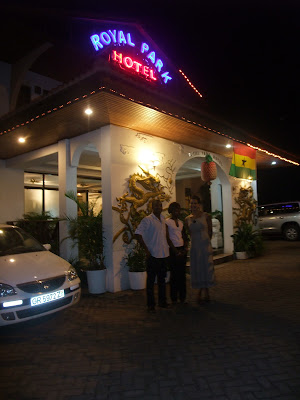
China’s presence is really inescapable in Ghana and there is no shortage of Chinese restaurants. After consulting with some of the Ghanaian medical students, we decided that Royal Park Hotel probably offered the most authentic Chinese food in Kumasi. After anxiously anticipating the food all day, we arrived at the door steps of the Royal Park Hotel, which was fully decorated with comforting Chinese vestiges—golden dragon wall hangings, stone guardian lions, and a big red carpet with the characters Huan Ying Guang Ling 歡迎光臨 (Welcome).


When we walked in, I saw other Asian people in the restaurant—always a good sign, even in the US, that the food should be decent. As we sat down at our round table complete with a lazy sally, I felt like I had reached my oasis. I poured through the menu and ordered over 40 Cedi worth of food, just for myself. They sadly did not have my wontons, bok choy, or the beef chowfun that would have made the perfect meal, but over six pages of other good options. I ended up ordering Jiachang Tofu 家常豆腐, beef lomein, Royal Park’s twist on lettuce wraps, and pan fried pork dumplings. The fatty in me made a valiant effort to clear the table in one sitting and I ended up with just two take-out boxes…not bad, right?

My overall opinion of Royal Park’s Chinese food? Out of five stars, I’d give it three. It was certainly better than Panda Express or your average Chinese American restaurant called any iteration of Lucky Bamboo or Happy Ding. But, it wasn’t fabulous. If in the US, Royal Park would not be a Chinese restaurant that would deserve a second visit. But, since I’m in Ghana, if I’m ever overcome with the overwhelming need to eat Chinese food, I’ll be back at Royal Park devouring another four dishes on my own.

Tuesday, July 13, 2010

Another Ghanaian Food Update

The Ghanaian food journey continues. Below are some local food highlights. I don’t think variety is a characteristic of Ghanaian food…I just may have tried it all within three weeks!

Before I go on, I will admit that I broke my rule of not eating any non-local food within the first week I was in Ghana. We discovered the famous obroni restaurant, Vic Baboo’s, while wandering around Kumasi and just had to stop in to try it out. Vic Baboo’s is an Indian restaurant that claims to serve local food, American, Italian, Indian, and Chinese. I went with Indian since it was an Indian restaurant and Erika went with Hawaiian pizza--both were pretty good!

Sir Max is another obroni option in Kumasi that I think is owned by Lebanese folk. We went to Sir Max with a few of the Ghanaian med students and I don’t think they are big fans of middle eastern food. I think they were actually disgusted by the baba ganoush I ordered.

Fufu


Fufu is a very unique type of Ghanaian dish. It looks like a ball of dough, but is actually pounded and mashed plantains and cassava mixed together. I think the mixed ball of dough is then boiled/steamed, but I’m not sure, especially since obroni usually get diarrhea after their first time eating fufu (thank goodness this didn’t happen to me!). Fufu is eaten with light soup, a spicy tomato based stew that has meat and fish poured on top of it. What may be fun for some is that you typically eat this dish with your hands. I say “fun for some” because I have this inexplicable fear of eating in public because I don’t like making a mess while I’m eating and having everyone see it. I generally avoid foods like ribs and wings when at restaurants even though I think they are tasty. I prefer a white pasta sauce over red and I eat messy finger foods with utensils. So, you can imagine how painful it was for me to eat fufu with my hands especially when the hospital administrator’s wife was staring at me. I was told that you were not supposed to chew on the fufu and just swallow it. That’s not difficult to do, but it seems so strange. So, I’d let it slosh around my mouth once or twice to taste it and then swallow. The fufu is kind of bland and tasteless. You can almost taste the plantain, but not really. I thought the light soup was super spicy. I guess the fufu is a good flavor balance to the light soup. After humoring the hospital administrator’s wife by eating with my hands. I gave up and asked for a spoon.

Just a few days later, the hospital administrator’s wife asked me to help her prepare fufu. It is usually prepared by two people. One person sitting by the mortar adding water to the mixture and folding the “dough” and the other person standing holding a large stick of bamboo with a flat blunted end to act as the pestle. I was very unsuccessful at the pounding because I was afraid I’d squash the hospital administrator’s wife’s fingers. I was also very reluctant to put in work and energy after showering into something I didn’t think was all that appetizing. The cost of sweating was not worth it! Thankfully, I think she got frustrated with my hesitant pounding and asked a scrawny fifteen year old to help her who was much more forceful with her pounding. Cost: 2 Cedi

Banku


Banku can be seen as a variation of fufu, but made of slightly fermented maize meal and mashed cassava. Banku also has that big ball of dough appearance but has a little more stiffness to it…kind of like oatmeal that doesn’t have enough milk in it. Instead of light soup, Banku is eaten with okra (okro in Twi) stew. If any of you have cooked with okra before, you know that it has a sliminess to it. Chopping up okra leaves is actually slimier. The okra and okra leaves are what give the soup is gooey texture. The okra stew is also tomato based and includes palm oil (red in color) and fish. Banku is also eaten with your hands. I never thought I’d be thankful for the power going out, but I used my difficulty of eating in the dark to get a spoon to finish off my Banku. I actually really enjoyed Banku. I think it’s because I really miss the taste of vegetables! Cost: 2 Cedi

Jollof Rice


Jollof Rice is a spicy type of rice usually served with chicken. I’m not quite sure what actually gives it it’s orange color and spicy taste, but my guess is the red pepper that’s used in almost every Ghanaian dish. It could also be Shito sauce (a horribly named spicy tomato/fish sauce). My guide book calls this the West African paella, but I haven’t seen Jollof rice served with anything but chicken, so I don’t think that’s the best description. Cost: 3-5 Cedi

Rice/Noodles/Yams with Tomato Stew


Because food is extremely hard to come by out in Agroyesum, the Matron’s sister cooked for me while I was there. I think it’s now clear that she’d try to cook me “American” dishes for dinner, which I really appreciate even though everything came with a Ghanaian twist. Most of my Ghanaian-American dishes included a starch (rice, noodles, yams) along with a tomato based stew that included either chicken, beef, or fish with some chopped cabbage, green pepper, and onion mixed in. The tip-off that I was eating Ghanaian-American dishes rather than true Ghanaian dishes was when I got an entire pot filled with French fries in it and when I offered them to the hospital administrator’s family, they refused them! I’ve never met anyone who didn’t like French fries. They said that they didn’t like potatoes. This confuses me since I don’t think potatoes taste all that different from the water yam… Cost: 2-6 Cedi

Red Red


In my previous blog post about Ghanaian food, I described fried plantains served with a bean stew. It has just been clarified that this dish is called Red Red. I still think hands down that fried plantains are my favorite Ghanaian thing to eat. Cost: 2-8 Cedi

All of the above are sold on the streets, though, unlike other countries I have visited, street food is a lot less common in Ghana. You can’t really eat your way through a city. I think this is why eating and finding food is so difficult in Ghana. A trip out to get food always takes at least an hour (not including the incredibly slow service at restaurants). Below are few things that you can also pick up on the street but are not really restaurant menu items.

Ghanaian Sandwich


I don’t actually know how common this type of sandwich is, but here’s Ghana’s take on an American staple: bread, onions, lettuce, chicken, beans, hard boiled eggs, ketchup, and mayo. I bought this sandwich as alcohol poisoning prophylaxis, but I think the combo of ketchup and mayo only added to me confirming any American partying stereotypes. :( Cost: 2 Cedi

Fried Egg Sandwich

If you are really craving a nice departure from rice based meals or need a quick protein heavy breakfast, a fried egg sandwich is a great cheap option. The fried egg sandwich is exactly that, but a few things to keep in mind: 1) The eggs are smaller in Ghana and the yolk is not very yellow. Don’t be fooled, egg whites only is not the standard here. The yolk is in there somewhere. 2) Without even asking for it, you will sometimes get egg sandwiches with a few diced tomatoes and green onions (aka the Ghanaian Spanish omelet). Beware if you don’t like tomatoes or green onions. 3) Bread is sold by length rather than slices. To make a sandwich you’ll probably need about 30 peswas (Ghanaian cents) worth of bread. Cost: 1 Cedi

Meat Pies


If you’ve ever been to a potluck that my family has been invited to, you will know what Chinese curry pockets are. I like to think that this is Ghana’s version of my mom’s Chinese curry pockets. The Ghanaian version is really just a meat pie that normally doesn’t have that much meat in it. I can’t put a finger on the spices in the meat. One meat pie had a sun-dried tomato flavor to it. The pastry portion of the pie is very flaky and very dry, so eat with plenty of water! Cost: 50 peswas to 1 Cedi

Goat/Beef Kebobs


Of all of the advice my mentor gave to both Erika and I before leaving us in Ghana to fend for ourselves, he was most enthusiastic about Ghana’s goat kebobs. This is definitely your typical type of street food: a guy standing behind a unstable looking grill. These kebobs can be of any type of meat, but I’ve seen only goat and beef so far. You can also get any part of a cow, except I have not seen cow tongue, which I told one griller would be a hit, but he didn’t believe me. The meat is marinated in the same red pepper and the kebobs are cooked upon order. So, as you are salivating, you are also praying that the meat is cooked well and that the hot metal grid is hot enough to kill anything that could kill you! Cost: 1 Cedi per kebob

After almost a month in Ghana, I’m seriously craving some good Chinese food. My sister’s Shanghai food pictures only add to my cravings. After Erika’s very unfortunate Chinese sweet and sour chicken at Vic Baboo’s I’m going to steer clear of anything Ghanaian-Chinese…It’s really too bad that I’m flying back straight to Ann Arbor, where the Chinese food is not really great. I really should make a pit stop at home!

Sunday, July 11, 2010

It's Too Sweet


I did it! I succeeded in making my host family and St. Martin’s hospital cupcakes and cookies…well kind of. I made carrot cake cupcakes (courtesy of Betty Crocker) with frosting and peanut butter cookies (thank you Jess!).

It was not difficult to procure all of the necessary ingredients and except for the incessant pleas from the twins to help, it was not difficult to mix the correct ingredients together either. Baking the goods was a small obstacle since the oven available was a gas oven that did not have a temperature gauge. I was thus forced to sit in the hot kitchen to watch my cupcakes and cookies bake. I can only hope that Eva’s sweat did not become part of the recipe.


As I laid the stunted but finished goods on the table, I couldn’t wait for everyone to try them! The hospital administrator’s home became the place to visit. I asked the medical officers, the matron, the cook, and everyone else I could flag down to stop by and take some cookies and cupcakes. I am disheartened to report that the reception of the cupcakes and cookies was far less than enthusiastic. Everyone was very impressed with the appearance and process of baking. But, every bite into either a cupcake or cookie was met with a nose crinkle, a request for some water, and a seemingly forced positive comment. After three of these reactions, I gave the cupcakes and cookies a try and tasted nothing unusual or disgusting (thankfully). I actually felt a huge wave of American comfort in sampling the cupcakes and cookies. After my fourth negative response, I asked what was wrong and the lab technician said that the cupcake and cookies were too sweet!

In retrospect, this reaction makes sense. If the Ghanaians don’t normally eat dessert, then of course this will be too sweet. I did anticipate this with the cookies and cut out a lot of sugar from the recipe, but perhaps that was not enough. The only people that seemed to thoroughly enjoy the cupcakes and cookies as much as I did were the twins. I suppose Jess’s suggestion of making fajitas was the better option…

Tuesday, June 29, 2010

Cooking in Ghana


I’ve been staying in a guest room attached to the hospital administrator’s house at St. Martin’s Hospital in Agroyesum for the past two weeks. Everyone in the hospital has been extremely gracious and accommodating from helping out with my research to letting me observe in the hospital to trying to cook American food for dinner for me. Besides inundating them with Michigan gear, I wanted to do something more personal for everyone, so I thought I’d cook…something Chinese or American.

However, this is a lot easier said than done. Obstacles I need to navigate:

  • Daily irregular power outages
  • Vegetables available: lettuce, green peppers, green onions, onions
  • Meat available: chicken and maybe goat
  • Seafood available: canned mackerel
  • Carbs available: rice, bread, spaghetti, yams, plantains
  • Spices available: salt, cayenne pepper
  • Other proteins: peanut butter, beans, eggs
  • No cheese
  • Unclear on the pots and pans available
  • My own limited cooking repertoire

The unavailability of pork or even better ground pork eliminates a lot of Chinese dishes that would have been fun to demonstrate like wontons and dumplings. I didn’t want to make fried rice because they have that and I didn’t want to make a noodle dish like lomein because that again is too similar to what they already eat. I could do Chinese cold noodles, but I’m not sure if peanut butter sauce would be a hit. No cheese means no Italian. After much thought and remembering that Opoku Trading Center, an “Abrofo Market” (White Man’s Market) in Kumasi, carried cake mix, I decided to bake cupcakes. For those cupcake masters reading this, yes, I’ll be making them with a mix rather than from scratch…don’t judge! The typical Ghanaian meal never seems to include sweets or dessert, so this will hopefully be unique enough.

This past weekend, I went to Kumasi and bought cupcake pans and cake mix. Maybe muffins will be a better description since frosting may be hard to pull off…we’ll see what I can do. Wish me luck! I really hope this won’t turn into a disaster! Pictures to come soon.

What Chinese/American dish would you have suggested to best showcase a different cuisine?

Mango Season is Over!


I have been in Ghana for exactly three weeks and have still only eaten about 5 mangoes. Why is this number not 21? One for every day I’ve been in Ghana like I had hoped it would be? As I sadly found out from the Ghanaian medical students, mango season is over!!!!

In Ghana, mango season is usually from January to about May. That is why I rarely see any on the street and the ones that I buy are less than spectacular. Argh…! This has got to be my biggest disappointment in Ghana, especially since mango season just started at home in Florida. This is an even greater disappointment than inconsistent electricity, running water, mosquitoes, and inefficient work streams.

Anyone want to send me some mangoes?

Saturday, June 12, 2010

Ghanaian Food Update

It's a rule of mine while traveling to try my best to immerse myself in the local food as much as possible and avoid all and any food I can find in the US. I'm off to a pretty good start. I have managed to eat only local Ghanaian foods. Here's a quick description of things I've tried. Thank you to Roshan for giving me a quick Ghanaian food overview before leaving!

Note: If you are on a no carb diet and love vegetables, the Ghanaian diet may be a little difficult to handle...

Chicken and Fried Rice (not sure if this is truly Ghanaian)


The fried rice is similar to Chinese fried rice just minus the soy sauce. The fried chicken is seasoned in what I think is red pepper. Great easy meal to start with in Ghana. Cost: 3.5 Cedi (1 Cedi ~ 0.75 US cents)

Waakye, Gari, Spaghetti, Fried Chicken


Waakye is rice and beans similar to rice and beans dishes found in Central and South America, but much heavier on the beans. Gari is fried and ground cassava. Spaghetti is simply noodles with no sauce though usually served plain with waakye and gari. The fried chicken was again seasoned with red pepper, so slightly spicy. Cost: 4-7 Cedi

Fried Plantains, Fried Chicken, Stew


If you've never had fried plantians, you don't know what you are missing! The Ghanaian version of fried plantains is a little different than the type that you'd find in Central and South America. It is a little frier and definitely not as sweet. Fried plantains are my favorite Ghanaian food that I've stumbled upon, so far. I've asked for just fried plantains as a meal. I don't know if the stew has a more official/descriptive name. It tasted like chilli and had beans and onions in it. It was very spicy, probably due to the red pepper that they use to season the fried chicken. Cost: 4-8 Cedi

Palava Sauce


Palava sauce is some kind of vegetable mixed with some red pepper and fish and made into a sauce. Sauce may not be the best description since it is not a pure of these ingredients and not really these ingredients sitting in a broth. Maybe stew is a better term. It is kind of like Indian food dishes and is used similarly. Palava sauce can be served on top of a bed of rice or eaten with Ampesi (steamed plantains or yams). The sauce is a little spicy and the vegetables add a nice refreshing taste to it. Roshan, THANK YOU for this recommendation. Cost: 2-8 Cedi

Here is a great website with probably more accurate descriptons of Ghanaian food.

More food soon!

Thursday, June 10, 2010

Where are the mangos?

It is mango season in Florida. And according to every friend I've talked to about a summer in Ghana, it's supposed to be mango season in Ghana as well. So, where are the mangos?

I've walked up and down some streets and see a ton of mango and papaya trees...but no fruit! I brought a Swiss army knife with me for the sole purpose of cutting mangos. At this point, I feel like it was a smart idea to bring this bag of dried mangos, since this is all I've been able to eat!