Mona monkey eating bananas at Boabeng-Fiema Monkey Sanctuary
I can't believe I'm already at this point, but I took my last tourist trip this weekend! Since it was my last trip, I made sure that it would be blog-worthy.
It all started with hitch-hiking a ride from Tamale to Kintampo to meet the IFMSA obroni coming up from Kumasi. I am still very surprised that this haphazardly orchestrated "let's meet up somewhere in the middle of Ghana" plan worked out. I am indebted to the nice gentleman from Accra who was willing to give me a ride.
The roads are infinitely smoother from Tamale to Kintampo than they are from Kumasi, so I ended up arriving at the town's center much earlier than my Kumasi obroni. While waiting at the gas station (called filling stations in Ghana), I run into the Minister of Foreign Affairs of Ghana, Muhammad Mumuni. He was on his way to Tamale and unfortunately got a flat tire and was waiting for the tire to be changed. While we were both waiting, we discussed several topics including the public school system in Ghana and fufu. He greatly admired the shirt I was wearing that said, "Make Fufu. Not War."
After waiting for about twenty minutes, I decided that it would be best if we continued driving towards Accra and attempt to deliberately run into my friends from Kumasi so that this nice gentleman could make it to Accra by sunset (a 12 hour drive). After relaying my plans to my flatmate Shy, who was leading the obroni from Kumasi, we were on our way-- keeping our eyes wide open for a white tro-tro filled with obroni. After just 10 minutes of driving, we found them! There is apparently just one road you can take all the way from Tamale to Accra, which passes through Kumasi, so it was inevitable that I'd be reunited with the obroni.
Bringing an AADT Dai dance pose to Kintampo Waterfalls in Ghana
As soon as I climbed into the tro-tro, we sped towards Kintampo to our first destination, Kintampo Waterfalls. For a 2 Cedi admissions fee, you gain access to these gorgeous waterfalls. I thought it was too cold for a swim, so I busied myself as group photographer. The rocks just underneath the waterfall are very slippery and arranged in such a way that you can slide down the side slopes of the waterfall. The falls are located at the bottom of a small hill and at the top are pavilions perfect for a picnic. We were in a rush to reach our next destination, so after drying off, we were back on the road.
Our next and last stop on this trip was the Boabeng-Fiema Monkey Sanctuary. Even though I'd already been to Mole, I just had to see more animals! At the sanctuary, you can see two species of monkey: the playful Mona monkey and the shy Colobus monkey. Like Mole National Park, the animals at the Boabeng-Fiema Monkey Sanctuary live side by side with the humans of the village. Since most of my assumptions about animals in Ghana had been scrapped on my visit to Mole, I was shocked to see that the Mona monkeys loved interacting with humans and eating bananas! I suppose the association between monkeys and bananas extends far beyond Curious George. The Mona monkeys were all very excited to grab bananas and peanuts right out of our hands!
Just a small note: Although the Mona monkeys live freely with the villagers, two Canadian visiting zoology students reminded us that these monkeys were still wild. Our tour guide probably would never admit to this, but there have been cases where the monkeys would bite or attack the human tourists if they ever felt threatened. So them feed with caution!
Hitch-hiking, waterfalls, and monkeys! What better way to usher in my last week in Ghana?
As I’m writing, Szoa and I sitting in a makeshift bus station in Kumasi impatiently waiting for our journey to Wa to visit IHI’s Project Fives Alive’s project sites in the upper west of Ghana to begin. I cannot wait to get to the north to spend some time with the Project Fives Alive team and to recommence my search for mangoes (perhaps I love mangoes too much). I’ve already waited about two and a half hours and have just learned that we have about an hour left before the bus begins to board. This “organic” process of transportation is very frustrating since I hate idle time. Could I have taken another mode of transportation to avoid this three hour wait in a dusty station?
Generally, getting around in Ghana is fairly easy and inexpensive, but riddled with delays. Here are some considerations that must be factored in before embarking on a trip:
If a Ghanaian tells you that they will meet you somewhere at a specific time, expect at the very least a 15 minute delay. Like Asian time and Hispanic time, nothing ever runs on time.
Distance:
It takes on average about 20 hours to travel from the northern border of Ghana (Paga) back to southern border (Accra).
Quality of Roads:
Even though a town may be geographically close, if the roads have not been paved, your travel time will increase significantly. As I was planning my trip to Wa, I had the option of taking a flight into Tamale from Accra followed by a bus from Tamale to Wa. This seemed like the fastest route since Wa is in the next district west of Tamale. However, since the roads between Tamale and Wa have not yet been paved, the travel time between Tamale and Wa would take about the same time as a bus directly from Kumasi to Wa.
City Congestion:
If y’all thought New York City was congested, just come to Ghana and you will be surprised. Because public transportation systems don’t quite exist, the roads are “choked” with lots and lots of cars. Drivers are very aggressive here and will squeeze into any space available. A five minute journey could be a thirty minute ordeal during rush hours--usually it is much faster to walk in these cases.
Type of Transportation:
The smaller the vehicle, the faster it travels. A large bus generally will take much longer than a taxi. The age of the vehicle is also important factor in its speed. The older the car, the slower it will drive.
Who’s driving?:
The traffic rules in Ghana are very loose. Speed limits and traffic lights are merely suggestions. So, if the roads are clear, a fast driver will speed his way down the road until the road becomes congested. 90% of the cars in Ghana are manual, stick shift cars. This added control makes it relatively easy for the drivers to abruptly stop the car if needed.
Given these factors, I decided to take a large and established (though apparently not reliable) bus to Wa from Kumasi. Here are some other transportation options that I could have taken:
Drop-In Taxi:
Drop-in taxis work exactly like taxi’s in the US. You stand on the side of the street to flag a cab down, or walk to a cabstand. Though, before opening the cab door, you must negotiate and agree on a cab fare. Since cab fares are always inflated for obroni, be sure to verify the price with locals. Travel within Kumsai should never cost any more than 4-5 Cedi.
Shared Taxi:
There are some taxis that simply drive up and down some of the main city roads or highly frequented routes. If there are empty seats available in the cab, you can share a cab with strangers and pay a greatly reduced fair to arrive close to your final destination. A drop-in price of 4 Cedi reduces to 60 peswas in a shared taxi.
Tro-Tro:
Tro-tros are old refurbished vans that travel almost all over Ghana at a very low cost. Each tro-tro can hold about 15 or so people legally. A porter assists the driver by calling out the final locations that the tro-tro will travel between. He also collects the tro-tro fare and alerts the driver when to stop to drop-off passengers and pick up new passengers. While some drivers will try to squeeze as many people into one van as possible, there are random police checkpoints along the roads that will fine drivers for overcrowding. Tro-tros only leave when the tro-tro is full, so that is an important delay that you have to take into account when planning trips. Tro-tros are probably the riskiest form of transportation in Ghana given how old the vans are and how recklessly the drivers drive. But, if you are on a budget, they are a very affordable option.
MetroMass Buses:
These buses are government owned buses that connect most of the major cities and townships all across Ghana. Because these buses are government owned, the price is highly subsidized. Fortunately, unlike the tro-tros, these buses kind of run on a schedule. They have a certain number of routes a day and will leave within two hours of their reported departure time. If you are not traveling a long distance or don’t mind the lack of air conditioning, this is another very affordable and more reliable option. Usually, advance tickets are not needed.
STC Buses:
These buses are a step up from MetroMass. They are newer and are a little more reliable. But, they have less routes than MetroMass. You normally do have to purchase tickets in advance or arrive very early and hope that there are spaces left.
Motorbike:
In the north, the land is much flatter and as a result, one of the major forms of transportation is the bicycle or motorbike. However, motorbikes are not available for “rent.” To take advantage of the motorbikes, you will need to know someone who owns one for a ride.
Hitch-hiking:
Ironically, in a foreign country where everyone is a stranger, hitch-hiking is a very viable option for obroni in Ghana. Twice, I have been lucky enough to meet generous strangers who offer to drop me off at a city on their way to their final destination. They ask for absolutely nothing in return and simply tell me that this is the Ghanaian way. As a caveat, this is not to say that everyone offering rides is a safe option. As my dad has ended every conversation I’ve had with him since I’ve been in Ghana: be smart and be safe.
The bus to Wa has finally completed boarding. It’s now five hours after the original departure time. Let’s just hope that these six hours to Wa are safe and as they say in Ghana, snappy, too!
Even though I get to travel and see different parts of Ghana almost every day on my site visits to district hospitals, my trip to Cape Coast was something special.
The KNUST-SMS Medical Students Association Exchange Committee organized a Cape Coast trip for all of the foreign and foreign-exchange students two weeks ago. Cape Coast is a seaside city known for its beautiful beaches and castles that preserve the history of the slave trade in Ghana. We were truly an international group. There were about thirty of us with representatives from Ghana, the UK, Denmark, Switzerland, Norway, Germany, Greece, Austria, Poland, Spain, and me (go USA!). From Kumasi, it takes about four hours to drive down to Cape Coast, and a portion of the ride is extra bumpy due to bad roads. Since I was one of the smallest people on the trip, I had the honor of being squeezed between two seats since there were not enough seats for everyone on the bus. These conditions could have made the trip unbearable, but the good conversations and incredible barfroat (delicious fried dough) made all the difference.
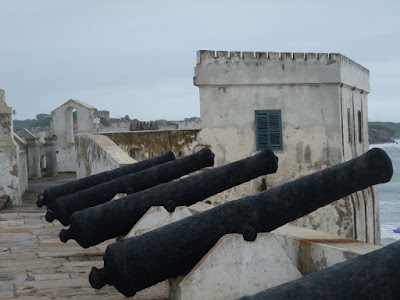
Cape Coast Castle
Cape Coast Castle
Our first stop when we arrived in rainy Cape Coast was the infamous Cape Coast Castle. Even though my family and ethnic heritage has no direct connection to the slave trade, as an American, walking through the Castle was an extremely profound experience. The staff at the Castle provided an excellent walking tour and the Castle is very well-preserved. Standing in a dark dungeon with one tiny hole for air circulation (its true purpose of construction was not to provide the slaves more bearable conditions, but to monitor the activity of the slaves within the dungeon), my heart fell to the ground when I heard that this tiny room was meant for hundreds of slaves—forced to not only sit In their own waste, but among the dead and dying as well. I felt embarrassed and ashamed to be an American—tied to this atrocity against humanity. I was very surprised to see the Ghanaian reaction to the Castle. Perhaps it is because most of them have visited the Castle before since they only seemed to react to my sullen humiliation: “It’s okay. This happened a very long time ago.” The Castle staff was very proud to say that President Obama and Michelle Obama came to visit the Castle when they were in Ghana. They were so emotionally touched that they cried. The Cape Coast Castle can really elicit those feelings. Even now, once you walk through the “Door of No Return,” your life is forever changed.
Erika's Surprise Birthday Party!
The Cape Coast trip was organized in conjunction with the University of Ghana Medical School in Accra. It was a great opportunity to meet some other foreign exchange students, but most of all this meant that I got to see Erika! Erika had moved from Kumasi to Accra for the second phase of her research. The timing of the trip was perfect because Erika’s birthday was that week. Shy and I tracked down a place (gas station “bakery”) where we could buy a birthday cake and we carried the cake all the way from Kumasi to Cape Coast to surprise Erika. I am happy to say that the cake survived the bumpy four hour journey with just minimal frosting damage thanks to Prince’s promise to guard the cake with his life. This small birthday celebration was the perfect way to end the day.
Edwin is shaking in his shoes while walking through Kakum National Park
As a contrast: Shy is so confident that he's trying out some fancy moves
The next morning, we set off to Kakum National Park, just outside Cape Coast, to walk through the rainforest at the level of the trees along canopies. Being a rainforest, it rained as we climbed, but the rain stopped just as it was our turn to walk on the canopies. Since the trees are so dense, the elevation was difficult to gauge and this should have made those afraid of heights feel better. However, in our international group the boys were unexpectedly the most nervous about the walk. It was entertaining to see these really tall Ghanaian guys inch their way across the seven legs of the canopy walk and even more fun to occasionally give them a little scare by jumping up and down.
Cocoa pod and cocoa seed
Even the cocoa pod is yummy!
Ever wonder where chocolate comes from? Usually, the sweet and divine burst of chocolate in my mouth overtakes my senses so all I appreciate and think about is the goodness in my mouth. But, since cocoa is one of Ghana’s major industries, and I’ve been unsuccessful in finding true Ghanaian chocolate in Ghana, I was very curious about where chocolate comes from. Just outside the canopy walk, several farmers sell cocoa pods. These pods kind of look a little like a yellow-colored cross between papaya and squash. Inside the pods are cocoa seeds. The seeds are covered in this white fruit that resembled and tasted like mangosteen. To make chocolate, these seeds are collected, dried, and ground into cocoa. Chocolate lovers beware: the fresh seed may look like a delectable truffle, but it is extremely bitter. DO NOT chew on them!
Mawsie and I enjoying the beach
We spent the rest of the day relaxing along the Cape Coast beach at Alberta’s Cottage (a small resort). Perhaps this will only be significant to east coasters…I was on the other side of the Atlantic!!! A short aside about Project Eva’s Tan. My skin complexion has always been a pasty, almost glow in the dark pale white. As hard as I try, I’m never able to achieve the much desired illustrious golden sparkle that all Floridians seem to have naturally. One of my ulterior goals this summer was to get some solid work done on Project Eva’s Tan. Unfortunately, that cloudy Saturday at Alberta’s Cottage was proof that higher powers were not going to make it easy for me to complete my project. Despite the overcast sky, there was plenty to enjoy on the beach. There were plenty of coconuts to eat and drink (50 peswas), mesmerizing green waves that’d make any surfer excited, and impromptu soccer games on the beach. I brought along a teeny Frisbee and much to my surprise, we got a good game of beach ultimate going! We continued our festivities into the night at a beachside outdoor club/restaurant called Oasis. Oasis is a very popular place, especially among foreigners. Though personally, I would have preferred singing to a ukulele around a bonfire on the beach.
Elmina Castle
We set off early the next morning to visit Elmina Castle. Elmina Castle is another vestige of the slave trade presence in Ghana. The Castle itself is much bigger than Cape Coast Castle and its exterior appearance is beautiful. I’m not sure if it was the sunny weather or the Dutch origins of Castle, but I was not as emotionally moved while touring the Elmina Castle. However, the atrocities that took place there are no different than what we saw at Cape Coast Castle. We had just a few hours after touring Elmina Castle and our journey back to Kumasi. We spent those last few hours a bigger and very obroni friendly beach resort: Coconut Grove Beach Resort. Because I grew up in Florida, I’m a bit of a beach snob. I have only been impressed with a few beaches in my travels (Hawaii, Santa Monica, Cape Cod) and I prepared myself to be disappointed in Cape Coast. But, I’m happy to say that I was pleasantly surprised. I highly recommend the beaches in Cape Coast. Everything is almost exactly the same as the beaches in South Florida, including the shell-based sand. The only major differences are the water on this side of the Atlantic is green rather than blue and the waves are much bigger. With the sun blazing, I spent most of that afternoon working on Project Eva’s Tan. We tossed the Frisbee for a bit and just as we were ready to start a game, it was time to go.
If I have a few extra days to travel at the end of my work here in Kumasi, Cape Coast would definitely be a place I’d revisit.
I may have been here over a month, but I continually have to remind myself that I'm spending my last summer (ever!) in Ghana. Although I'm in a foreign country, I'm going to try to squeeze in all the things I normally like to do in the summer while here in Ghana. What do I usually associate with summer? Watermelons, mangoes, BBQs, Ultimate Frisbee, Shakespeare on the Commons, fireworks, ice cream, strawberry shortcake, ice tea, picnics, outdoor concerts, and yes, mosquitoes. There are only a handful of must-do summer activities that I can think of that don't revolve around food. The most important of those activities ever since I moved away from living in the sunshine state of Florida is swimming, especially swimming at the beach.
As I was preparing for my trip, most of the warnings and messages of concern I got from friends and family were centered not on being abducted, mugged, or killed, but were about germs and diseases. Ghana is not the filthiest place I've ever traveled to, but disease is a very real concern. So, if you are planning a trip to Ghana, check the CDC website and do make sure your vaccines are up-to-date (yellow fever, hepatitis B, typhoid, meningitis, polio, hepatitis A) and bring malaria prophylaxis with you. Aside from these vaccine preventable diseases, a type of bug that you may encounter in Ghana that I never think about are parasites, both the intestinal and crawling through your skin and anywhere else in your body forms. Parasites. This was what was standing in the way of me being able to swim in Ghana.
Ueli, Shy, Alister, and Erika swimming at Golden Hotel in Kumasi
So, where can I go swimming in Ghana? Are any of the bodies of water safe? Swimming pools are actually common in the major cities, especially at hotels and resorts. KNUST also has an Olympic-sized pool for the more competitive type of swimmer. Although I never asked how often these pools were cleaned or the source of the pool water, I assumed that since most of these pools charged a small fee (3-15 Cedi) to swim that they must be safe. Since I normally spend most of my time in a pool doing handstands and playing games like "Marco Polo", these options were plenty.
Margrit, Edwin, and I at Lake Bosomtwi
Another option about an hour away from Kumasi by tro-tro is Lake Bosomtwi. Lake Bosomtwi is Ghana's largest natural lake created by meteorite impact. It is situated in the middle of a rain forest and surrounded by lush mountains (Wikipedia calls them hills but I think they are super tall so qualify as mountains). If you have ever been to Taiwan's Sun Moon Lake, this is Ghana's version of the tranquil and picturesque getaway.
The lake is believed to be sacred by the Ashanti (largest tribe in and around Kumasi) and the villagers fish only on wooden planks so as not to disturb the spirits in the lake. The most interesting fact about the lake for tourists is that it's supposedly schistosomiasis free! Schistosomiasis is a very nasty parasite that lives in fresh water and penetrates human skin and then can bury and disrupt the function of many organs including the liver and brain by launching a damaging immune response. According to the guide, no one has ever gotten sick from swimming in the lake. Despite this allegation and seeing tons of my friends step into the lake for a swim, I was not willing to risk it. After the alleged parasitic worm infection I had while in Mole, I'm done with worms. But, as long as you are not a hypochondriac med student, I'm sure swimming in Lake Bosomtwi is perfectly safe. I on the other hand, will stick to the pools. We are off to Cape Coast next week, so maybe I'll get my beach swimming in then!
For Independence Day weekend, a cohort of the University of Michigan students in Ghana came together to take a road trip up to Mole National Park to go on a Ghanaian safari. I was extremely excited to go on this trip even though my African animal knowledge is limited to Disney’s The Lion King and trips to zoos like the San Diego Zoo and Disney’s Animal Kingdom.
Up until the trip, I had not seen many animals at all. Perhaps it was incorrect for me to assume that there would be monkeys walking along the streets with people like dogs. Don’t ask why I thought this would be the case. I blame The Lion King and TV for misinforming me. What I have seen is a “safari” of small critters and bugs in my “own backyard” that would make anyone who hates bugs and is a medical student who has passed infectious diseases (me) a paranoid wreck. Here are a few of these critters:
Mosquitoes are my number one concern even though they are not anything new to a South Floridian. If I wasn’t such a mosquito magnet, then perhaps I wouldn’t be so concerned. If you are ever in the same room with me, you’ll be safe. No mosquito bites for you. The added worry is malaria, which is a very real concern. Of the district hospitals I have visited so far, malaria is always one of the top five complaints. And two of my Ghanaian medical school friends have come down with malaria. Two things I must manage to do consistently every day: shower myself with OFF and take my malaria prophylaxis (doxycycline). While I was in Agroyesum, sleeping with a mosquito net was an absolute must. Every day is a battle against these mosquitoes and I fear that I am losing. Mosquito bite count as of today: 19
Centipedes and all other insects are significantly bigger here! The first time I saw a centipede curled up on the ground I thought it was a snake! I was even told that drying your laundry outside is a hazard because the tsetse fly will lay its eggs into your clothing. Dr. Abram’s videos of the bot fly are still fresh enough in my mind to motivate me to dry hang my clothes indoors.
Scorpions are not common, but since arriving in Ghana, I have come across three. These killer critters are also unexpectedly large. The largest one I’ve seen was the size of a blue crab. The movie, Scorpion King, took place in Africa, right?
Lizards and other reptiles are very common here. Many of the houses here are covered by a metal sheet and if you hear rumblings across your roof, it’s most likely a lizard scurrying across the roof. The coloring of the lizards is very different from those found in South Florida. I’m actually comforted by the lizards because they remind me of the lizards that run rampant in South Florida.
Parasitic helminthes. I had a worm scare Independence Day weekend because I was experiencing extreme fatigue, a fever, complete loss of appetite, and GI irritation. Since the twins I lived with while in Agroyesum were reported to have worms, I knew it was only a matter of time before I developed worms since we ate the same food and drank the same water. While exchanging Ghanaian experiences with the rest of the University of Michigan students, I learned that two of them had worms in their feet! Worried about my well-being despite the potential positive benefit of a parasitic worm helping me lose some weight, I adamantly requested for a de-wormer pill upon arriving back in Kumasi. I do feel better now…
Chickens. Almost every meal in Ghana includes fried chicken. After walking around the streets, this will come as no surprise given the number of chickens roaming around, even within hospitals! Thankfully, these chickens do not all crow at dawn every morning. Rather, the cock-a-doodle-doo can be heard at any time during the day. Every time a chicken crosses my path, I wonder if he will be a part of my next meal.
Goats. Roaming goats are much more common in the districts than in Kumasi, but you can still find them jumping across gutters and picking through trash. There is nothing really special or unique about these goats. Goats around the world must be the same.
While these critters keep my daily life in Ghana exciting, they do not beat being able to walk around Mole National Park and standing just a few meters away from these amazing animals:
Blurry, but Erika's standing over a crocodile!
Crocodiles: The first stop on our road trip to Mole National Park was Paga, a town at the border of Ghana and Burkina Fossa. These crocodiles are unique because they are tame and live side by side with the people of Paga. Legend and folklore have the people of the village intertwined with the lives of the crocodiles. Each crocodile represents a human spirit. We unfortunately arrived in Paga too late to get the best of pictures.
Any mention of Paga always brings up a misinformed debate about how to tell the difference between a crocodile and alligator. Since few believe being a Floridian with alligators in her backyard is a credible source of information, here is a link that details the differences.
Warthogs: The Lion King really did get this one right. Warthogs are not very majestic and are the “pigs” of the African wild. They were also much bigger than I had anticipated. At Mole, they run wild in the reserves, but also coexist with the humans living in Mole. If you are not careful, they will step onto your veranda in search for food. The most entertaining thing about the warthogs is how they eat. Since they have very short necks, they will bend down on their knees to eat. Though, I don’t remember Pumba doing this in The Lion King.
Yeah for Baboons!
Baboons: They were everywhere! They roamed around the villages, hung around the water towers, climbed up along the soccer goal posts, and were found walking around the reserves. Though they are hairier then we are, the similarities in their mannerisms is really uncanny. Baby baboons cling onto their mother’s backs not too unlike how babies in Ghana are strapped to their mother’s backs; the baboons groom with meticulous scrutiny; the curious stares they give you only reflect our own curiosity; and they sit on “toilets” to pass waste.
The female water buck who caused the fights
Antelope and Water Bucks were the hardest to track because they would flee at any sound. We were only able to catch them from a distance and hear the rustle of their graceful run. The antelope and water bucks are very territorial. Other male antelope and water buck cross into the marked territory of another male at their own risk. However, all females are allowed to cross. The most intriguing thing we were able to see was a fight between two male water buck for a female water buck.
An elephant track...are we close?
Elephants!!! Mole National Park has hundreds of elephants roaming its reserves. Despite this great number and the large size of these majestic animals, it was extremely difficult to find and see elephants. Our first safari walk in the late afternoon yielded no elephants. But, the next morning, we all woke up to take the 6:30AM walking safari to see elephants before leaving Mole. After wandering around for about an hour seeing plenty of elephant tracks and the constant buzz of horse flies driving me insane, I was about to give up. But, then, our rifle-carrying guide came through for us and we found eleven elephants! The African elephant is much bigger than its Indian cousin. The most obvious difference is probably the shape of its ears: large and square compared to the smaller and triangular ears on the Indian elephant. As we approached a watering hole where the elephants were bathing, it began to smell like a circus (my most memorable elephant encounter before Mole), so I knew we were in the right place. Watching the elephants bathe and throw sand on their backs as insect repellent was an unforgettable experience. I can’t think of any other animal that has the same silent magnanimity.
Here's an excellent video of an elephant painting!
If you are ever in Ghana, I’d highly recommend making the trip out to Mole National Park for the extremely affordable opportunity (5 Cedi to enter with student ID and 3 Cedi per hour for the walking safari) to walk along with the animals of the Ghanaian wild because you’ll only see pesky critters in the cities.




 While these critters keep my daily life in Ghana exciting, they do not beat being able to walk around Mole National Park and standing just a few meters away from these amazing animals:
 Blurry, but Erika's standing over a crocodile!


 Posts

